The Minister of Culture and Sports, Patricia del Pozo, supervised the dismantling operation of the Church of Lord Saint George and the Hospital of Holy Charity, which will be exhibited starting June 30 at the Museum of Fine Arts in Seville. The exhibition, open until spring 2026, will delve into the iconographic discourse devised by Miguel Mañara around the works of mercy.
Patricia del Pozo emphasized that «the exhibition will offer a unique opportunity to deeply understand one of the peaks of the Baroque period, providing direct access to masterpieces by Murillo, Valdés Leal, Pedro Roldán, and Duque Cornejo located at different heights on the walls of the church or part of its altarpieces.»
In this regard, the Museum of Fine Arts exhibition will be divided into three areas addressing respectively the production of Bartolomé Esteban Murillo, Juan de Valdés Leal and the sculptures for the church of the Brotherhood of Holy Charity, a Sevillian institution dating back to the 15th century devoted to serving the most underprivileged.
The exhibition will bring together seven Murillo canvases: ‘The Multiplication of the Loaves and Fishes’, ‘Moses Striking the Rock at Horeb’, ‘Saint Elizabeth of Hungary Healing the Lepers’, ‘Saint John of God Transporting a Sick Person’, ‘The Incarnation’, ‘Child Jesus’, and ‘Child Saint John the Baptist’, along with three by Valdés Leal, the two canvases of ‘The Last Things’ (‘The End of World Glory’ and ‘In the Blink of an Eye’) plus a portrait of Mañara.
Additionally, the Museum will also exhibit the following sculptures: the Virgin of Charity, an anonymous carving with polychromy executed by Valdés Leal; the two lamp-bearing angels by Pedro Duque Cornejo, the ‘Ecce Homo’ by brothers Francisco and Miguel García, and the Christ of Charity, Saint Roch, and Saint George, three works by Pedro Roldán.
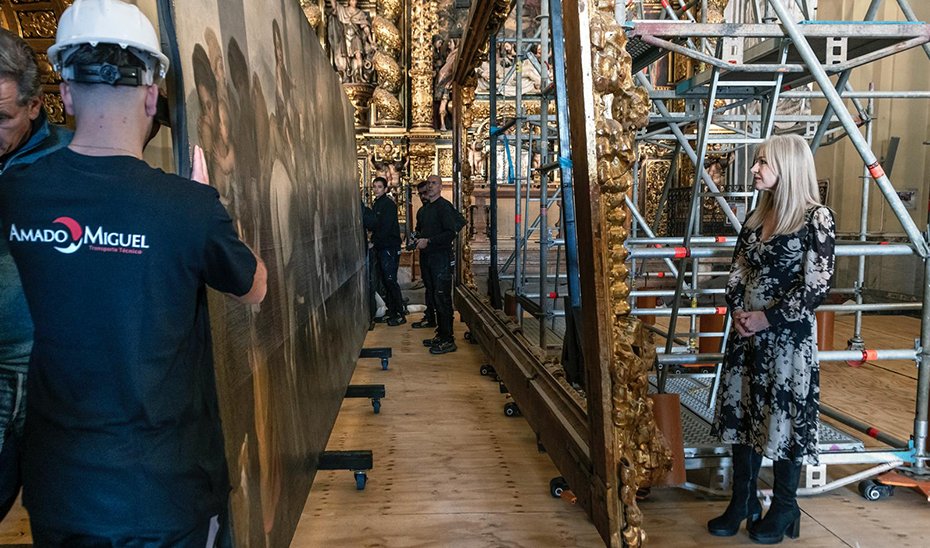
Minister Del Pozo, accompanied by the head of Holy Charity, Félix Arenado, and the director of the Fine Arts in Seville, Valme Muñoz, witnessed the dismantling of the canvas ‘Moses Striking the Rock at Horeb’, executed by Murillo and placed several meters high on the Gospel wall of the church’s antepresbytery.
The large canvas – 236 x 575 centimeters – depicts the act of charity of giving water to the thirsty, recounting the episode of Moses striking the rock to bring forth water in the desert. The narrative of this work is drawn from the Old Testament, from the Book of Exodus (17:1-7), where Moses intervenes to quench the thirst of the Israelites crossing the desert.
Specifically, Moses, alongside his brother Aaron, implores the Lord’s help, leading him to strike the rock at Horeb with a rod to produce a powerful stream of water. The scene portrays a wide range of human attitudes, gestures, and reactions stemming from popular beliefs, expressing both those who have quenched their thirst and those who have not.
The exhibition aims to explore the iconological program that Miguel Mañara conceived for the Church of Lord Saint George at the Hospital of Holy Charity in Seville, where the integration of architecture, sculpture, and painting offers a significant example of the Baroque approach to total artwork and presents a paradigmatic instance of public staging of Baroque religiosity.