The Great Power is one of the images that arouses the most anticipation in the Holy Week of Seville. Not only because it is a popular devotion that goes beyond the borders of Andalusia, but also because of the artistic values of a carving created by Juan de Mesa in 1620, considered a masterpiece of Baroque iconography. In the early hours of Good Friday, the also known as ‘Lord of Seville’ will once again process through the streets of the Andalusian capital, on a float designed and made by Francisco Ruiz Gijón in 1688, which is considered by specialists as a «mobile altarpiece», whose design has become a model and inspiration for processional floats for the rest of the brotherhoods in the autonomous community.
The float, the oldest currently in penitential station in Andalusia, underwent a meticulous restoration at the Andalusian Institute of Historical Heritage (IAPH) almost three decades ago, an internationally recognized conservation institution dependent on the Ministry of Culture and Sports. The intervention allowed the aesthetic values of a float suffering from significant support and polychromy issues to be reintegrated. After the process, it regained its dimension as a microarchitecture of great artistic quality, with its imprint of matte gold, the transparency of the latticework of the basket, and the combination of stuccoed and gilded surfaces that give it its characteristic theatrical and Baroque setting.
This conservation project for the Great Power float marked a turning point, says Rocío Magdaleno, head of the workshops department at the IAPH Intervention Center. «It transformed the way of approaching the restoration of floats with professional criteria. Previously, restorations were carried out by artisans, but from that project onwards, they will be carried out with scientific criteria, turning the IAPH into a knowledge agent of these processes. The project, furthermore, was the first financed through the Andalusian R&D Plan, in collaboration with universities and international organizations».
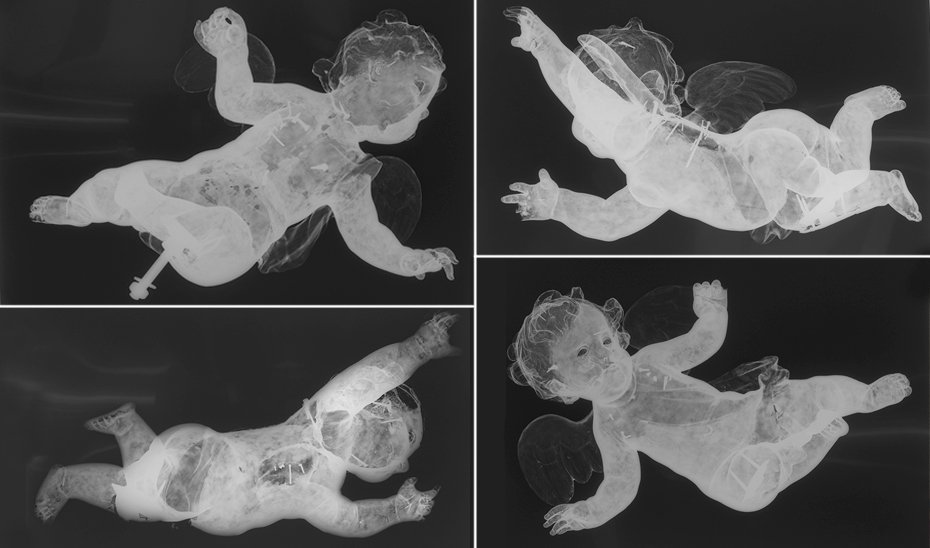
Image and study of one of the angels from the Great Power float in Seville.
During this process, institute technicians took X-ray photographs of the float, in which standout in the basket, among other elements of vegetation and animals, twenty-four round sculptures of angels in different positions that, in a dynamic arrangement, engage with the viewer, and are complemented by six larger passionate angels at the basket corners framing the Great Power carving.
Some of those angel images taken at the IAPH are displayed in the exhibition ‘The Revealed Image’, which showcases X-rays of 49 assets, from around thirty Andalusian brotherhoods and fraternities, subjected to study and restoration processes over the past thirty years, revealing a unique image of Baroque works by creators like Juan de Mesa and Ruiz Gijón, as well as Pedro Roldán, Juan Martínez Montañés, José de Mora, and Juan Bautista Vázquez ‘El Viejo’, among others.
The view of these X-ray images for a non-specialized audience allows «to bring our work closer with a didactic purpose,» says this restorer, expanding the scientific culture of society on such a sensitive topic as historical heritage, promoting the need for conservation and care. But the exhibition also offers the opportunity to approach these religious images in «a different way and enjoy their own beauty. In the case of the Great Power angels, the X-rays are placed at the entrance of the exhibition, serving as a welcoming introduction to the show, representing the revealed image and light as knowledge. Additionally, the beauty of the angels is very defined in these photographs«.
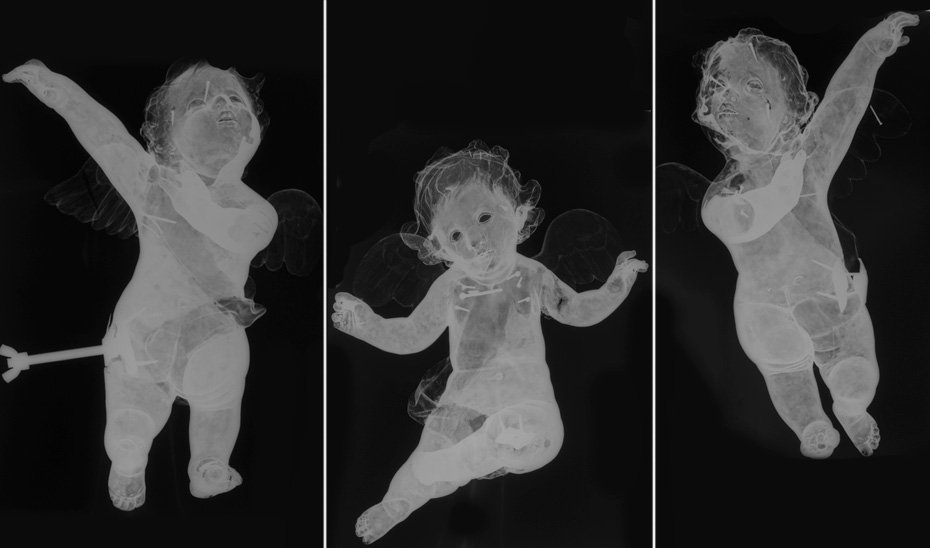
Pieces that can be visited in the exhibition ‘The Revealed Image’.
These final concepts, beyond the metaphor, also refer, explains Magdaleno, to the scientific data provided by these X-ray images, allowing to understand the «internal structure of all hidden elements in the sculptures that cannot be seen otherwise. Along with CT scans, this technique is essential for sculpture restorations and provides tremendous information, ranging from material density to interventions carried out on the work. Even for historians, it provides information on construction techniques or modifications made by the artist himself».
In the case of the Great Power float, the angels have been repainted on several occasions since their original construction, but these interventions «maintained a quality that did not justify their removal. The float’s angels, in particular, have had three documented previous interventions: in 1775 there was a first one on the passionaries, which were recomposed; another between 1965 and 1969 in the workshop of Antonio Castillo Lastrucci, where pieces were replaced, especially; and a final one in 1988 in the workshop of Cayetano González. The IAPH restoration was carried out between 2011 and 2012″.
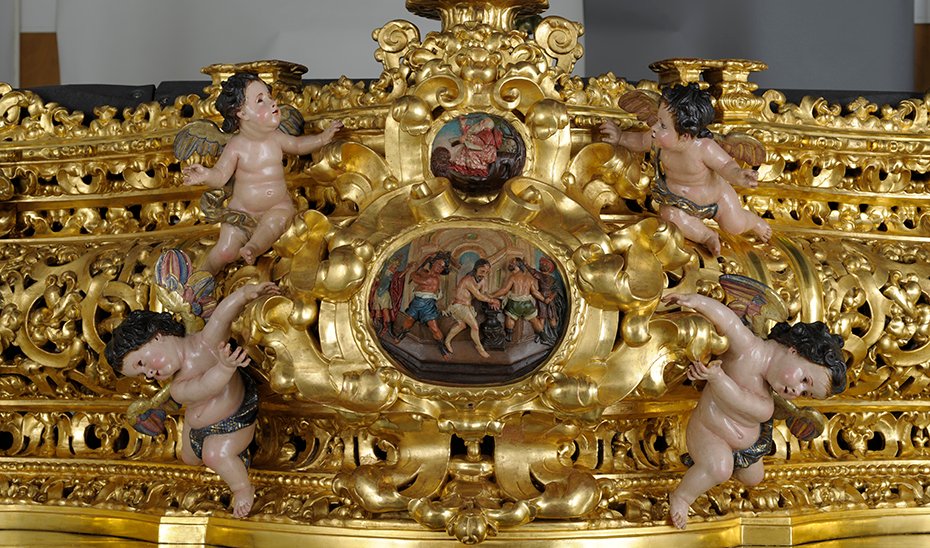
Detail of the basket of the Great Power float.
The IAPH restoration, with a budget of 137,000 euros – most of which was contributed by the brotherhood itself – focused on support and polychromy issues, as well as fissures and cracks. In the case of the angels, «there were small losses, such as the little fingers of some pieces, and of polychromy, where there were some cracks. There was also intervention on the darkening of varnishes that hid the original chromatism. The angels, in general, as they were very well constructed, did not have assembly issues in the central body of the float».
The results of the restoration have been appreciated by the brotherhood members for over a decade during the Seville ‘Madrugá’, but these days they can also visit the institute to discover the hidden light shown through X-rays by these angels of the float basket. Alongside these images, the exhibition also showcases other interesting X-rays of carvings such as the Nazarene of Forgiveness, by Juan de Mesa; the Christ of Providence, by Montes de Oca; and the Christ of the Expiration from the Museum, by Marcos Cabrera, among others.

Float designed and made by Francisco Ruiz Gijón in 1688.
In this way, the exhibition showcases X-rays of sculptures with significant historical-artistic weight that have gone through the image examination techniques laboratory of this institution, dependent on the Ministry of Culture and Sports, in its thirty-five years of trajectory. In that sense, it is worth mentioning that the IAPH, in Seville alone and in the last decade, has carried out over 200 conservation and restoration actions related to sacred art.
‘The Revealed Image’ can be visited in the exhibition hall of the IAPH Lego Cloister, in the Cartuja Monastery of Seville, during Tuesday to Friday, from 10 am to 1 pm and from 5 pm to 8 pm; Saturdays, from 11 am to 2 pm and from 5 pm to 8 pm; and Sundays and holidays, from 11 am to 2 pm. During Holy Week, the exhibition will only be open to the public on Tuesday and Wednesday mornings. The exhibition will remain open until May 30 and admission is free.